What Is a Registered Agent and Do You Need One?
Every LLC needs a registered agent but what is one and should you hire a service or do it yourself.
What an LLC is and how it compares to other business structures
Every LLC needs a registered agent but what is one and should you hire a service or do it yourself.
5 states — States that legally require an LLC operating agreement: California, Delaware, Maine, Missouri, New York $0 — Cost to create an operating agreement using free templates — no lawyer required for basic LLCs 1 page — Minimum length of a legally sufficient single-member LLC operating agreement in most states $3,000 — Estimated cost…
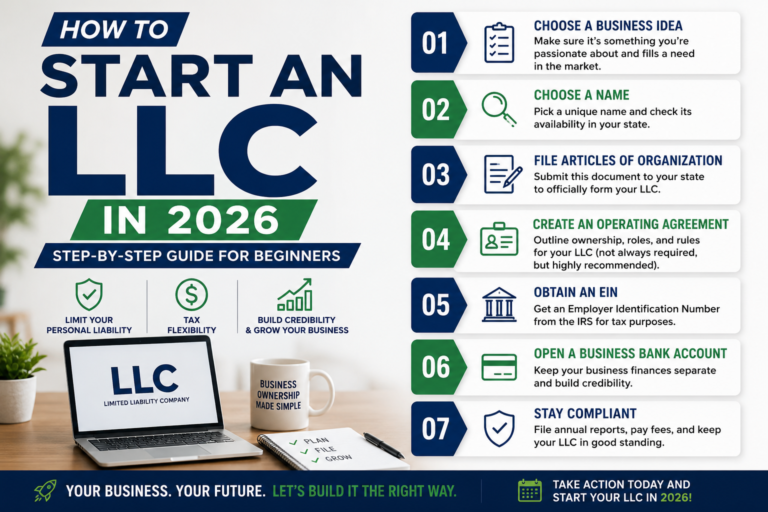
How to Start an LLC in 2026: Step-by-Step Guide for Beginners Starting a Limited Liability Company (LLC) is one of the smartest moves an entrepreneur or small business owner can make. An LLC protects your personal assets from business debts, provides tax flexibility, and gives your business a professional, credible structure — all with relatively…
One of the most common questions from aspiring business owners is whether they need to hire a lawyer to form an LLC. The honest answer is — it depends. For many simple single-member LLCs, DIY formation is completely reasonable. For more complex situations, legal guidance is worth the investment. This guide helps you figure out…
TITLE: LLC for Freelancers: Do You Really Need One? FOCUS KEYWORD: LLC for Freelancers often wonder whether forming an LLC is worth the cost and effort. The honest answer depends on your income level, the types of clients you work with, and your personal risk tolerance. This guide helps freelancers make an informed decision —…
A single member LLC — an LLC with just one owner — is the most common LLC structure in the United States. It provides the same liability protection as a multi-member LLC with the tax simplicity of a sole proprietorship. This guide covers everything a solo business owner needs to know about single member LLCs….
Both LLCs and corporations provide personal liability protection, but they are very different structures with distinct tax treatment, ownership rules, and compliance requirements. Understanding the differences helps you choose the right structure for your business goals — and avoid expensive restructuring later. Disclaimer: This content is for informational purposes only and does not constitute legal…
When you start a business, your default legal structure is a sole proprietorship — you are automatically a sole proprietor the moment you start earning business income without forming a separate entity. But for most business owners, staying a sole proprietor carries significant risks. This guide compares an LLC and a sole proprietorship across every…
When you start a business, one of the most important early decisions is choosing your legal structure. For most small business owners, freelancers, and entrepreneurs, a Limited Liability Company — better known as an LLC — is the most popular and practical choice. This guide explains exactly what an LLC is, what protection it provides,…