
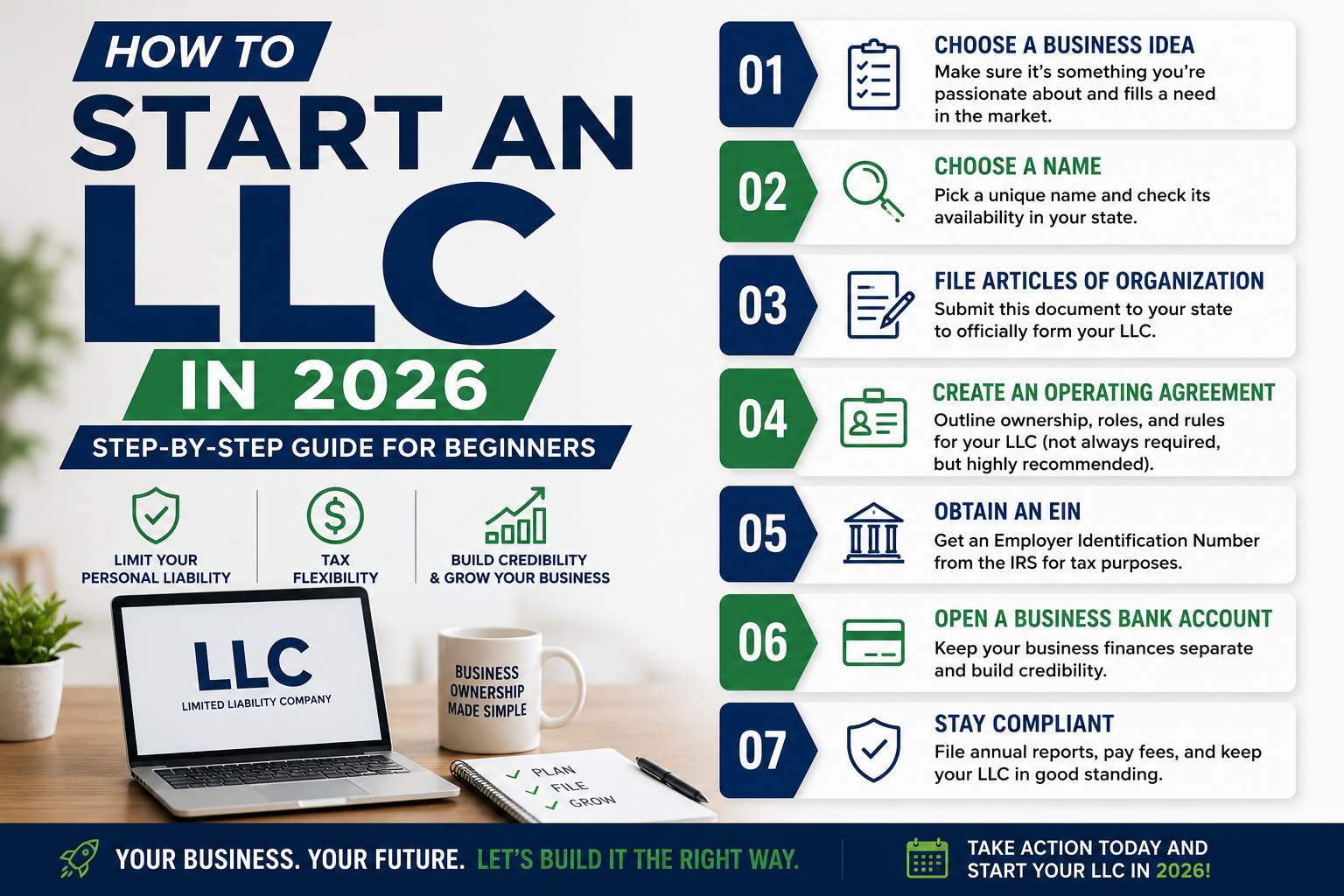
How to Start an LLC in 2026: Step-by-Step Guide for Beginners
How to Start an LLC in 2026: Step-by-Step Guide for Beginners
Starting a Limited Liability Company (LLC) is one of the smartest moves an entrepreneur or small business owner can make. An LLC protects your personal assets from business debts, provides tax flexibility, and gives your business a professional, credible structure — all with relatively simple paperwork and low costs.
Whether you are a freelancer, a side hustler, or launching a full-time business, forming an LLC in 2026 is straightforward when you know the steps. This guide walks you through exactly what you need to do, state by state, to get your LLC up and running.
What Is an LLC and Why Do You Need One?
An LLC — Limited Liability Company — is a business structure that combines the liability protection of a corporation with the tax simplicity of a sole proprietorship. The key benefits include:
Personal liability protection: Your personal assets — your home, car, savings — are protected from business debts and lawsuits. If your business gets sued or cannot pay its debts, creditors generally cannot come after your personal assets.
Pass-through taxation: Unlike corporations, LLCs are not taxed at the business level by default. Profits and losses pass through to your personal tax return, avoiding double taxation.
Credibility: Having “LLC” after your business name signals professionalism and legitimacy to clients, vendors, and banks.
Flexible management: LLCs have few formal requirements compared to corporations. No board of directors, no required annual shareholder meetings.
Step 1: Choose Your Business Name
Your LLC name must be unique in your state and must include “Limited Liability Company,” “LLC,” or “L.L.C.” Check name availability on your state’s Secretary of State website. Most states have a free business name search tool.
Choose a name that is memorable, easy to spell, and reflects your business. Avoid names too similar to existing businesses, which could cause trademark issues. Also check that the domain name for your business is available — having a matching domain and LLC name is ideal for branding.
If you want to use a different name for marketing purposes (different from your LLC’s legal name), you will need to register a DBA (Doing Business As) in your state, also called a fictitious business name.
Step 2: Choose Your State of Formation
Most small businesses should form their LLC in the state where they primarily operate. This is the simplest and most cost-effective approach for businesses with physical operations or employees in one state.
You may have heard that Delaware, Wyoming, or Nevada are favorable states for LLCs. This is true for large corporations or businesses with complex needs, but for a typical small business, forming in your home state avoids the complexity of registering as a foreign LLC in your operating state — which you would still need to do if you form out of state.
Wyoming is popular for online businesses with no physical location because it has no state income tax, low formation fees, and strong privacy protections for business owners.
Step 3: Appoint a Registered Agent
Every LLC must have a registered agent — a person or company authorized to receive legal documents, lawsuits, and government notices on behalf of your business. The registered agent must have a physical address in the state where your LLC is formed (not a P.O. box).
You can serve as your own registered agent if you have a physical address in the state. You can also use a family member or trusted friend. Many entrepreneurs use a registered agent service, which typically costs $50 to $150 per year. Services like Northwest Registered Agent, ZenBusiness, or Incfile provide registered agent services along with LLC formation.
Step 4: File Your Articles of Organization
The Articles of Organization (called Certificate of Organization or Certificate of Formation in some states) is the official document that legally creates your LLC. You file this with your state’s Secretary of State office.
The form typically asks for: your LLC name, your LLC’s principal address, your registered agent’s name and address, the names of LLC members (owners), and the LLC’s purpose. Filing fees range from $50 to $500 depending on your state. California charges $70. Delaware charges $90. Wyoming charges just $100. Texas charges $300.
You can file online through your state’s Secretary of State website, usually within 1 to 5 business days for standard processing. Expedited processing (same day or 24 hours) is available in most states for an additional fee.
Step 5: Create an Operating Agreement
An operating agreement is an internal document that outlines how your LLC will be run. Most states do not legally require one, but having one is essential for protecting yourself and your business.
A good operating agreement covers: ownership percentages, member roles and responsibilities, voting rights and procedures, how profits and losses are distributed, procedures for adding or removing members, and what happens if a member wants to leave or if the LLC dissolves.
For a single-member LLC, an operating agreement confirms that your business is a separate entity from you personally — important for maintaining liability protection. Many free templates are available online, or you can have an attorney draft one for $200 to $500.
Step 6: Get Your EIN (Employer Identification Number)
An EIN is like a Social Security number for your business. You need it to open a business bank account, hire employees, and file business taxes. Even if you have no employees, getting an EIN is highly recommended.
Applying for an EIN is completely free through the IRS website at irs.gov. The online application takes about 10 minutes and you receive your EIN immediately. You will need your LLC’s legal name, address, and the name and Social Security number of the responsible party (usually the owner).
Step 7: Open a Business Bank Account
This step is crucial and often overlooked by new LLC owners. Mixing personal and business finances — called “piercing the corporate veil” — can eliminate the liability protection your LLC provides. Always keep business finances completely separate.
Open a dedicated business checking account using your LLC’s EIN and Articles of Organization. Many banks offer free business checking accounts. Online banks like Relay, Mercury, or Novo are popular with small businesses for their low fees and excellent features.
Step 8: Obtain Required Licenses and Permits
Forming an LLC does not automatically give you permission to operate your business. Depending on your business type and location, you may need additional licenses and permits:
A general business license from your city or county. A seller’s permit or sales tax license if you sell physical products. Professional licenses for regulated industries like real estate, healthcare, or finance. A home occupation permit if you run your business from home. Check your state and local government websites for specific requirements for your business type.
Step 9: Comply With Ongoing Requirements
Maintaining your LLC requires ongoing compliance. Most states require LLCs to file an annual report and pay a fee to keep the LLC in good standing. Fees range from $25 to $800 per year depending on the state. California charges an $800 minimum annual franchise tax, which is one reason many entrepreneurs choose other states for formation.
Keep your registered agent information current, update your Articles of Organization if your address or membership changes, and file taxes on time each year. Failing to maintain compliance can result in your LLC being administratively dissolved.
Step 10: Understand Your Tax Obligations
By default, a single-member LLC is taxed as a sole proprietorship — all business income is reported on your personal tax return on Schedule C. A multi-member LLC is taxed as a partnership by default.
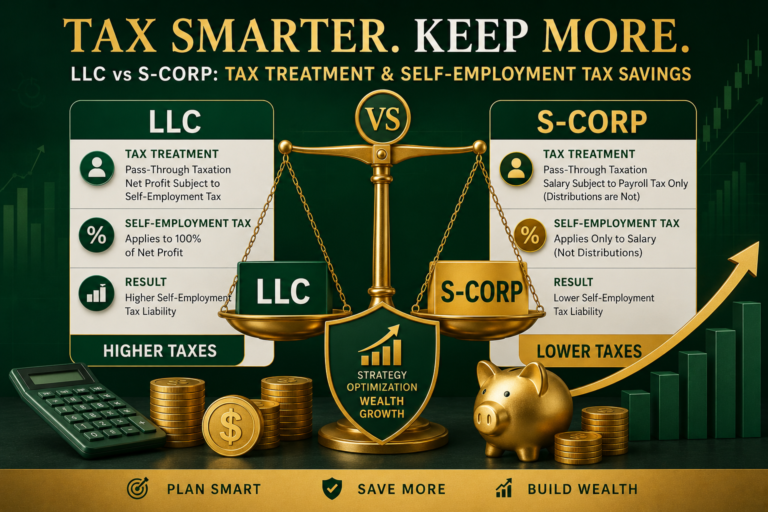
You can elect to have your LLC taxed as an S-Corporation, which can save significant money on self-employment taxes once your business is earning $50,000 or more in profit. Consult a CPA or tax professional to determine the best tax structure for your situation. The savings can be substantial — often $5,000 to $15,000 per year for a profitable business.
How Much Does It Cost to Start an LLC in 2026?
The minimum cost to form an LLC is just your state’s filing fee, which ranges from $50 to $500. For a basic LLC, your total startup costs might be $100 to $300, including filing fee, registered agent service for the first year, and an operating agreement template.
If you use a formation service like ZenBusiness (starts at $0 plus state fees), Northwest Registered Agent ($39 plus state fees), or LegalZoom ($79 plus state fees), the process is even easier but costs a bit more.
Start Your LLC Today
Starting an LLC does not have to be complicated or expensive. With this step-by-step guide, you have everything you need to protect your personal assets, legitimize your business, and set yourself up for long-term success. The hardest part is just getting started. Take action today and get your LLC formed — your future business self will thank you.
One Comment