
LLC Taxes Explained: How LLCs Are Taxed in 2026 (Complete Guide)
One of the most misunderstood aspects of LLCs is taxation. The confusion is understandable: an LLC’s tax treatment is flexible and depends on how many members it has and whether you’ve made any tax elections. What most people don’t realize is that the IRS doesn’t actually have a separate “LLC tax category” — instead, the LLC is taxed like one of the entity types it most resembles based on its structure. This guide clarifies exactly how your LLC is taxed in 2026 and when different tax strategies make sense.
The Fundamental Concept: Pass-Through Taxation
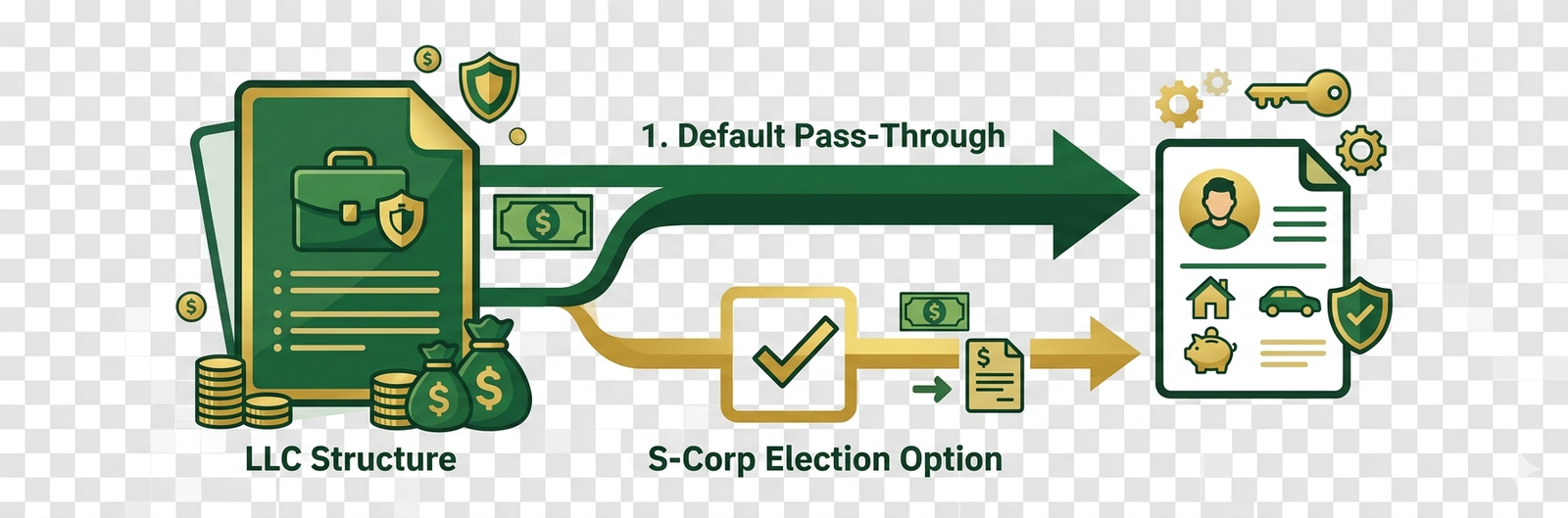
The defining tax characteristic of most LLCs is “pass-through taxation.” The LLC itself doesn’t pay federal income tax. Instead, profits and losses “pass through” to the members’ personal tax returns, where they’re taxed at the individual’s income tax rate. This avoids the “double taxation” of C-corporations, where the corporation pays tax on profits and shareholders pay tax again on dividends.
Tax Treatment by LLC Type
Single-Member LLC (Default: Disregarded Entity)
The IRS treats a single-member LLC as a “disregarded entity” — meaning it’s disregarded as separate from the owner for federal tax purposes. You report all business income and expenses on Schedule C attached to your personal Form 1040. You pay:
- Self-employment tax: 15.3% on net profit (up to the SS wage base), then 2.9% above that
- Federal income tax: At your marginal income tax rate on net business profit
- State income tax: Varies by state
This is effectively identical to sole proprietorship taxation, which is why the LLC’s value for single-member entities at low income levels is primarily liability protection rather than tax savings.
Multi-Member LLC (Default: Partnership)
A multi-member LLC is taxed as a partnership by default. The LLC files an informational Form 1065 (partnership return) but pays no entity-level tax. Each member receives a Schedule K-1 showing their share of profits, losses, deductions, and credits. Members then report their K-1 income on their personal returns and pay self-employment tax on their distributive share of ordinary business income.
LLC Taxed as S-Corporation
This is where significant tax savings become possible. An LLC can elect to be taxed as an S-corporation by filing Form 2553 with the IRS. Under this election:
- The member-owner pays themselves a “reasonable salary” as an employee
- The salary is subject to payroll taxes (Social Security and Medicare)
- Additional profits above the salary can be distributed as “owner distributions” — NOT subject to self-employment tax
S-Corp Election Tax Savings Example:
LLC net profit: $100,000/year
Without S-corp election: Self-employment tax = $14,130 (on first $100,000)
With S-corp election: Reasonable salary = $50,000. Payroll taxes on salary: $7,650. Distribution: $50,000 (no SE tax). Total SE/payroll tax: $7,650.
Annual savings: approximately $6,480
At $200,000 net profit with $80,000 reasonable salary: Annual SE tax savings approach $15,000–$18,000.
When Does the S-Corp Election Make Sense?
The S-corp election comes with additional administrative costs: payroll setup and processing, quarterly payroll tax deposits, W-2 issuance, and a separate S-corp tax return (Form 1120-S). These costs typically run $1,500–$3,000/year. The election generally makes financial sense when net profit exceeds approximately $50,000–$60,000 annually, at which point the SE tax savings exceed the additional administrative costs.
LLC Taxed as C-Corporation
An LLC can also elect to be taxed as a C-corporation (Form 8832). This is rarely beneficial for small businesses due to double taxation, but may be appropriate for businesses that intend to retain significant earnings in the business (not distribute all profits to owners), or that plan to raise venture capital. Most early-stage LLCs should avoid the C-corp election without specific strategic reasons.
Key LLC Tax Deductions You Should Know
LLC owners can deduct ordinary and necessary business expenses, including:
- Home office deduction: If you use a portion of your home exclusively and regularly for business
- Vehicle expenses: Business use of a personal vehicle (standard mileage rate: 67 cents/mile in 2024)
- Health insurance premiums: Self-employed health insurance deduction reduces AGI
- Retirement contributions: SEP-IRA (up to 25% of net self-employment income), Solo 401k (up to $69,000 in 2024 including employer contributions)
- Business equipment: Section 179 deduction allows immediate full expensing of qualifying equipment
- Professional development: Education, courses, books directly related to your business
- Software and subscriptions: Business tools, SaaS subscriptions, professional memberships
Quarterly Estimated Taxes: What LLC Owners Must Know
LLC owners typically don’t have taxes withheld from payments — they’re self-employed. This means you’re responsible for paying estimated taxes quarterly to avoid underpayment penalties. Quarterly due dates: April 15, June 15, September 15, and January 15. Pay at irs.gov/payments using your EIN or SSN.
Rule of thumb: pay quarterly installments totaling either 100% of last year’s tax liability or 90% of the current year’s expected liability (110% of last year if prior year AGI exceeded $150,000).
State LLC Taxes
State tax treatment of LLCs varies significantly. Notable situations:
- California: $800 minimum annual franchise tax for all LLCs regardless of income, plus a graduated LLC fee for LLCs with over $250,000 in California gross receipts
- Texas: No state income tax, but franchise (margin) tax applies to LLCs with revenue over $2.47 million
- New York: LLCs treated as partnerships; fixed filing fee based on NY gross income ($25–$4,500)
- Most other states: Pass-through taxation with annual report and fee; no separate LLC income tax
Frequently Asked Questions
Do I need a separate tax return for my LLC?
For single-member LLCs: no separate return (income reported on your personal 1040 via Schedule C). For multi-member LLCs: yes, Form 1065 partnership return required. For S-corp-elected LLCs: yes, Form 1120-S required. For C-corp-elected LLCs: yes, Form 1120 required.
When should I hire a CPA for my LLC taxes?
If you have a single-member LLC with straightforward income and expenses under $100,000: tax software (TurboTax Self-Employed, H&R Block) handles this well. When you have employees, multiple members, an S-corp election, significant deductions, or income over $100,000: a CPA more than pays for themselves through tax savings and compliance accuracy.
Can I deduct my LLC formation costs?
Yes — business startup costs (including state filing fees, legal fees for formation, and other organization costs up to $5,000 in the first year, with the remainder amortized over 180 months) are deductible. Track and deduct all formation expenses on your first year’s Schedule C or partnership return.
Conclusion
LLC taxation is more nuanced than most new business owners expect, but the flexibility it offers is genuinely valuable. From the simplicity of pass-through taxation at formation to the SE tax savings available through the S-corp election as you scale, the LLC tax structure rewards business owners who understand their options. Review your structure annually — the right election at $30,000 net profit might be different from the right election at $100,000. See our complete business setup guides on LLC formation and operating agreements for the full framework.